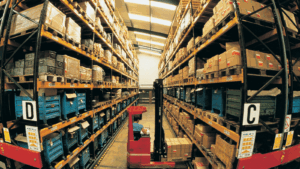

You need to organize the logistics of your storage space, but you don't know where to start?
In this article, you'll find all our tips and tricks for optimal Shelving : criteria and methods for good storage, an explanation of the ABC method and the most common contents.
Click here to discover our solutions for ergonomic shelving!
Criteria and methods for good storage
There are many things to consider when creating good storage.
Product safety
The first thing to consider when deciding how to store your stock is the condition of the products. The products you store need to be protected from heat, moisture, pests and other sources of damage. You also want to protect them from theft or damage caused by human error. If the warehouse is intended for long-term storage, or if the goods you're storing are sensitive to light or humidity, you may want to invest in a climate control system. This can help you control temperature and humidity levels so that your stock remains in good condition for as long as possible.
Storage space
The second thing you need to consider is how much space you have in your warehouse. If you don't have enough space for all your stock at once, it would be better for you to rent several warehouses in different locations rather than trying to put everything in one place at once.
Space safety
The last thing you should consider is whether storing your inventory in this location poses any security problems. If there are too many comings and goings on a daily basis, or if there isn't sufficient reliability, your inventory is at risk of being stolen or damaged by someone unfamiliar with the location.
The ABC method
The ABC method is based on the Pareto principle (80/20 law). By dividing your storage space into three parts, you can prepare your orders more efficiently. The 3 classes are as follows:
- Class A: 20% of your items represent 80% of your sales (high turnover rate). These products should be stored at the entrance and exit of your storage space, to ensure good organization. They are easy to reach, and can be found on the floor or on the first levels of shelves. It's important not to neglect the logistics of these products, which are essential to the smooth running of your stock.
- Class B: 30% of your items represent 15% of the value of your stock (average turnover rate). These products are usually placed in the middle of the warehouse and need to be closely monitored, as they are likely to move up to class A or down to class C. They really are the hub of your sales.
- Class C: 50% of your items represent 5% of the value of your stock (low turnover rate). These are the lowest-selling products in your stock. They can therefore be placed in the most inaccessible places or at height, for example on pallets.
Storage contents
Storage bins
Storage bins can be used to store small items such as screws, nuts, bolts or nails, which are likely to get lost or mixed up with other items during transport or handling. These bins can be kept on shelves or on the first floor of the warehouse, so that order pickers can access them easily when needed. They should also be clearly labeled to avoid confusion among employees when searching for specific goods, should several bins be needed to store similar items.
Barrels
Drums can be used to store liquids such as paints, which cannot be stored in bottles due to their consistency (the paint being too thick). Drums should be located close to the workshop so that people working in the workshop can use them.
Pallets
Pallets are ideal for storing heavy or bulky products. They enable safe Shelving , as well as effective use of the ABC method.
Here is a list of the most common storage methods:
- Stacking
- Hang on shelves
- On the floor
- Fill drawers and cupboards
- Packaged in boxes
In addition, there are three specific criteria for good storage:
- safety: you don't want things to fall on you or your belongings,
- accessibility: you need to be able to access everything quickly and easily,
- efficiency: you need to be able to reach the object you need without too much difficulty
Our material handling equipment specialists can help you customize your solutions and obtain tailor-made tools that perfectly meet the needs of your business.