
If you run a business and sell a lot of products, managing your warehouse storage is an essential step.
To ensure that your goods reach their destination, you'll find plenty of advice onoptimizing your warehouse in this article.
Optimizing your warehouse space
If you want to save space in your logistics warehouse, it's essential to optimize the flow of your goods. There are several types of racking that can help you achieve this optimization.
These can be mobile shelving, platforms or even storage towers. What's more, if you use shuttles or stacker cranes, you'll be able to make full use of your storage channels and warehouse height.
Order picking is one of the most important stages in your business.
The main warehouse management models
To best manage goods in warehouses, here are the main warehouse management models used by companies:
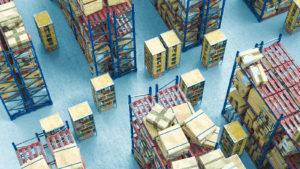
- The stacked warehouse: this is a warehouse that allows your goods to be stacked. All loading units are stacked on top of each other, leaving space for pallet handling. This model optimizes your floor space and guarantees a high level of warehouse saturation.
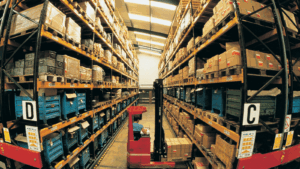
- Shelved warehousing: this model is suitable for non-stackable products, and allows load units to be placed on shelves. This type of model does not allow for space optimization.
- The cantilevered warehouse: this method is ideally suited to the storage of large, non-standard-shaped goods. This model can optimize a dedicated surface area.
- The compact warehouse: the compact warehouse is a model that eliminates aisles while maximizing the volumetric index. It also improves floor space performance, although it's essential to organize goods according to pick frequency and order.
However, if you have small goods, you can use shelves or drawers. To make the most of the space available, your products should be stored in order of preparation and size. This allows each drawer block or shelf to be used to avoid empty spaces.
In short, these methods enable you to better manage your inventory and save time when preparing orders.
Automating your productivity
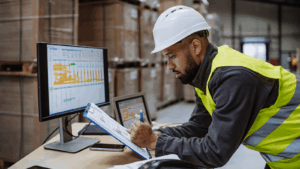
Automation is an important element in optimizing the efficiency of a warehouse. If all tasks are automated, this considerably reduces errors and difficulties for order operators. Today, there are many software packages available for warehouse management.
Software not only enables faster data collection, but also optimizes the tasks essential to order picking. In addition to automation, robotization also keeps your warehouse running smoothly.
The main automated storage systems for warehouses
Warehouse automation saves time and improves inventory management. Automated warehouse management has many advantages, but an organizational change is absolutely essential for it to work at its best. Here are the two main models:
- Automatic storage with a stacker crane: this model allows the stacker crane to pass through the aisles and retrieve both large and small goods. This system is managed by a computerized central unit that guides the stacker crane through all the aisles.
- Vertical storage with drawers: this model enables you to store a wide range of goods and optimize your warehouse space.