
Goods storage is an important part of any company's business. Between receipt and dispatch, the smooth transport of products is closely linked to the choice of the right storage equipment.
That's why it's important to opt for efficient materials handling storage solutions. There are a number of criteria that need to be met to find the right equipment for storing goods. Let's take a look at them together.
What are the characteristics of the storage environment?
The first thing to do is to define the various characteristics of the location in which you're going to place the products. Are they to be stored in a warehouse or office, i.e. indoors? Or can they be placed outdoors?
The importance of material
Knowing this type of information enables you to choose storage equipment made from the right material. With this in mind, for indoor storage, painted material will do just fine.
If you're planning to place your merchandise outdoors, we recommend you opt for galvanized material. This material offers excellent resistance to the elements. The storage material will therefore be protected from corrosion.
The weight
It's possible that the weight of the goods exceeds 500 kg and that they are stored in an outdoor warehouse. In this case, we recommend that you opt for sturdy storage equipment capable of withstanding such loads. It should also have a galvanized finish.
What type of products will be stored?
This is an important question to ask yourself before purchasing storage equipment: what products are you going to store? There are a number of sub-questions here.
Product characteristics, packaging, special features
To do this, you need to start by defining its various characteristics, such as volume, quantity, weight and size. Then think about packaging. Are you planning to do this in bulk, in cartons or through Palletization ?
You should also ask about the container in which the goods will be stored (tank, can, drum, jerrycan, barrel, chest, etc.). Finally, it's a good idea to know the specifics of the product to be stored. For example, is it an oily product? Is it greasy? Or is it a food product?
What are the loading options?
You also need to ask yourself this question before purchasing your storage equipment. With this in mind, you should consider the way in which the operator handles a product. This will help guide your choice of equipment, particularly in terms of safety and ergonomics.
Mechanical or manual?
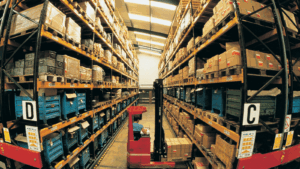
Goods can be loaded mechanically. In this case, the operation is performed by a Pallet truck. Products are then stored on a pallet Storage rack .
If the operator opts for manual storage of goods, then Shelving storage will be more suitable.
The importance of the order in which goods are received and dispatched
In the same vein, we also need to take into account the order in which products come in and go out. These are known as FIFO (first in, first out) and LIFO (last in, first out). The loading mode differs according to each case. We therefore advise you to opt for the Sliding Shelving system, to get an overall view of the goods stored.
What is the maximum load for the goods to be stored?
Before buying storage equipment, you need to consider the maximum load of your goods. This is crucial information. In fact, an incorrect estimate could lead you to buy unsuitable products. You risk wasting time and money. You also run the risk of damaging the merchandise.
Three categories of goods by weight
We recommend evenly distributing the maximum load per shelf. On the other hand, you can store your products in your warehouse according to their weight. It's a question of organization.
Loads up to 300 kg are suitable for light Shelving . For goods weighing between 300 and 700 kg, amedium-weight Shelving system should be chosen. If goods weigh more than 700 kg, choose a heavy-duty Shelving .
What is the volume of your products?
In addition to the environment, the type of product and its weight, you also need to estimate its volume. For example, if your merchandise is long (like boards), we recommend you choose a Shelving arm for long loads.
Are there any special requirements?
This is the last question you need to ask yourself before buying storage equipment. Will you be storing food products? Does the company need dynamic or vertical storage? Are certain products hazardous? There are storage products and shelving systems specially adapted to these needs.